Mobile Notary for Real Estate Closing Signings in Pasco County, FL: What to Expect
Reviewed/Updated: September 2026
Buying, selling, or refinancing property in Pasco County can involve a substantial amount of paperwork.
Many Florida real estate transactions include documents that require notarization, but that does not always mean you need to travel to a title company’s office. A mobile notary or Notary Signing Agent can meet you at your home, office, or another agreed location and complete the signing appointment according to instructions provided by the title company, lender, attorney, or other party coordinating the transaction.
Whether the property is in Land O’ Lakes, Wesley Chapel, New Port Richey, Trinity, Zephyrhills, Dade City, Hudson, Holiday, or elsewhere in Pasco County, here’s what to expect from a mobile real estate signing.
Why Is a Notary Involved in a Florida Real Estate Closing?
Florida real estate transactions often involve documents that must satisfy specific execution and recording requirements.
Under Section 695.03, Florida Statutes, an instrument concerning real property generally must have its execution acknowledged, proved by a subscribing witness, or otherwise authenticated as authorized by law before it is entitled to recording.
A deed transferring an interest in Florida real property has additional execution requirements. Under Section 689.01, Florida Statutes, a qualifying conveyance generally must be signed by the conveying party in the presence of two subscribing witnesses.
The Pasco County Clerk & Comptroller also publishes local guidance for documents submitted for recording.
The title company, lender, attorney, or other party responsible for the closing should determine which documents require notarization, witnesses, or other execution formalities.
What Documents Might Be in a Real Estate Signing Package?
Every transaction is different.
Depending on whether you are buying, selling, refinancing, or completing another real estate transaction, a signing package may contain documents such as:
- A warranty deed, special warranty deed, or quitclaim deed
- A mortgage
- Seller or title affidavits
- Loan documents and lender disclosures
- Closing or settlement documents
- Occupancy or property-related affidavits
- Tax-related forms
- Documents being signed by an attorney-in-fact under an approved power of attorney
Not every document in the package requires notarization.
Some documents may require only a signature or initials. Others may contain an acknowledgment, jurat, witness requirement, or another signing formality.
The notary or signing agent follows the documents and the instructions supplied by the hiring or closing party rather than deciding what legal formalities a particular transaction requires.
Learn more about our Real Estate Signing Services and Loan Signing Services.
What Does a Mobile Notary Do at a Real Estate Signing?
A mobile notary brings the signing appointment to an agreed location rather than requiring the signer to visit a notary office.
That may be your:
- Home
- Office
- Title or real estate office
- Hospital or care facility
- Another agreed public or private location
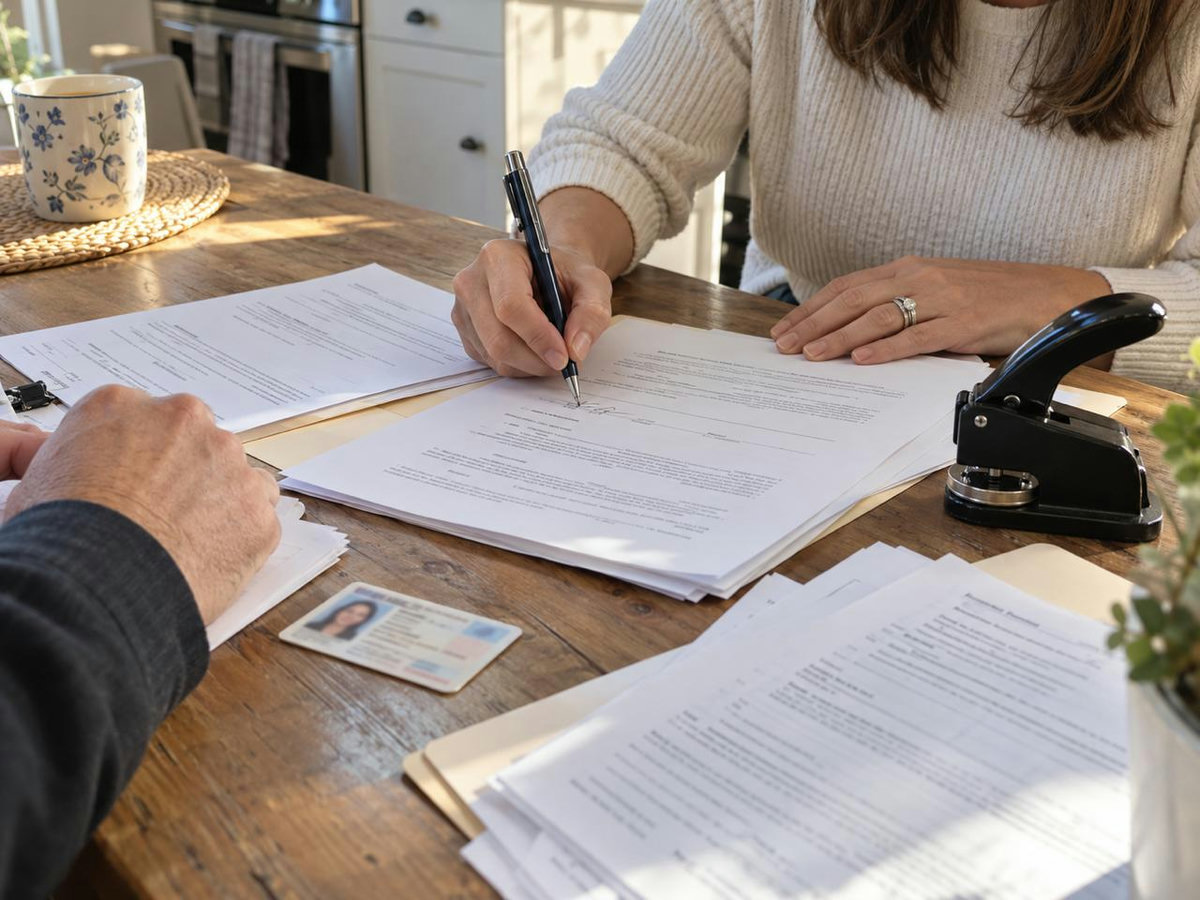
During the appointment, the notary establishes the signer’s identity, performs the requested notarial acts, completes the applicable notarial certificates, and follows the signing instructions provided for the transaction.
When acting as a Notary Signing Agent, the notary may also identify documents by title, indicate where signatures or initials are requested, check the completed package for missed signing locations, and return the documents according to the hiring party’s instructions.
“Notary Signing Agent” is an industry designation. It does not create additional legal authority beyond the notary’s commission or authorize the signing agent to provide legal advice, interpret documents, or make legal decisions for the parties.
The signing agent’s role is procedural and does not replace the title company, lender, attorney, settlement professional, or other party responsible for the transaction.
Can a Notary Explain My Closing Documents?
A notary or signing agent can explain the signing and notarization process.
For example, we can identify a document by its title, point to information already printed on the document, indicate where the document requests a signature or initial, and explain general notarial procedures such as the difference between an acknowledgment and a jurat.
We cannot interpret the legal effect of a document, tell you whether its terms are favorable, advise you whether you should sign, explain how a provision affects your legal rights, or change the terms of the transaction.
Questions involving your interest rate, loan terms, closing figures, title, ownership rights, legal obligations, or other substantive parts of the transaction should be directed to the title company, lender, attorney, or appropriate closing professional.
If a question comes up during the appointment, the signing can often be paused while you contact the appropriate party.
Does the Notary Have to Watch Me Sign Every Document?
Not necessarily.
It depends on the type of notarial act.
For an acknowledgment, a document may already have been signed. The signer must still personally appear before the notary and acknowledge executing the document.
For a jurat, the signer takes an oath or affirmation and signs or subscribes before the notary as required by the notarial act.
Florida’s statutory notarial certificate provisions appear in Section 117.05, Florida Statutes.
Because a real estate package may contain different types of documents, the safest approach is generally not to sign anything in advance unless the title company, lender, attorney, or signing instructions specifically tell you to do so.
What Should I Have Ready for a Mobile Closing Signing?
Before the appointment, make sure you have the identification and information requested by the party coordinating the closing.
Florida notary law recognizes several methods of establishing identity, but real estate transactions often have additional identification requirements imposed by lenders, title companies, or other receiving parties.
You may be asked to provide a driver’s license, passport, or another acceptable form of identification. Certain transactions may require more than one form of ID.
Review our What to Bring guide and follow any additional instructions provided by your title company, lender, attorney, or closing professional.
You should also have a quiet location where documents can be signed without unnecessary interruption.
Do All Buyers and Sellers Have to Be at the Same Appointment?
Not necessarily.
The required signers depend on the transaction and the documents being executed.
Rather than assuming everyone associated with the property must attend the same signing, confirm with the title company, lender, attorney, or other closing party exactly who must sign and how each person is permitted to sign.
Buyer and seller signing appointments may occur separately.
Some transactions may also involve a previously approved power of attorney or, where accepted, Remote Online Notarization.
If someone intends to sign as attorney-in-fact under a power of attorney, notify the title company or lender well before the appointment. Do not assume that presenting a power of attorney for the first time at the signing table means it will automatically be accepted for the transaction.
Florida powers of attorney governed by Chapter 709 have specific execution requirements. Under Section 709.2105, Florida Statutes, a qualifying Florida power of attorney generally must be signed by the principal and two subscribing witnesses and acknowledged by the principal before a notary public or as otherwise authorized by law.
The lender, title company, attorney, or other responsible party may also require advance review and approval of the power of attorney.
What About Witnesses for a Florida Deed?
Witnesses and notarization are separate legal concepts.
Under Section 689.01, Florida Statutes, a qualifying conveyance of Florida real property generally requires the conveying party’s signature to be made in the presence of two subscribing witnesses.
For many instruments executed in Florida and presented for recording, Section 695.26, Florida Statutes contains additional recording requirements, including requirements concerning the printed names and post-office addresses of witnesses and other persons whose signatures appear on the instrument.
That statute contains exceptions, so the requirements applicable to a particular document should be confirmed by the party responsible for the closing or recording.
The Pasco County Clerk & Comptroller provides current local recording guidance for deeds and other real-property documents.
If witnesses are required for your transaction, confirm the requirement with the title company, attorney, or other closing party before the appointment.
Tampa Bay Signing Services may be able to assist with witness logistics when arranged in advance, but we do not determine the legal witness requirements for a customer’s particular document.
Can My Pasco County Real Estate Signing Be Completed Online?
Potentially.
Florida permits Remote Online Notarization, commonly called RON, using compliant real-time audio-video technology.
A registered Florida Online Notary must be physically located in Florida while performing the online notarization. The principal does not have to be physically located in Florida.
Florida law also permits qualifying witnesses to participate remotely in certain electronic transactions, subject to additional statutory requirements.
For example, under Section 117.285, Florida Statutes, a witness who is remote from the principal must satisfy additional requirements, including confirming the witness’s qualifying U.S. residency and physical location within the United States or a U.S. territory at the time of witnessing.
If the principal is outside Florida, additional procedures apply under Florida’s online-notarization laws.
Florida law also permits electronic witnessing of qualifying real-property conveyances under certain circumstances.
However, the fact that Florida law permits online notarization or electronic witnessing does not mean every lender, title company, investor, title insurer, government agency, recording workflow, or individual transaction will accept it.
Always confirm RON eligibility with the party handling your closing before scheduling an online signing.
How Long Does a Mobile Real Estate Signing Take?
Appointment length varies.
A seller package or cash transaction may be relatively short. A financed purchase or refinance can involve a much larger document package.
Many real estate signing appointments take approximately 30 to 60 minutes, but the actual time depends on the size of the package, number of signers, identification requirements, witness arrangements, and whether questions must be directed back to the title company or lender.
The goal is not simply to move through the paperwork quickly. It is to complete the signing accurately and according to the instructions provided for the transaction.
What Happens After the Signing?
After the appointment, the signing agent may check the package for required signatures, initials, dates, and completed notarial certificates within the scope of the signing instructions.
The documents are then returned or transmitted according to the instructions provided by the title company, lender, attorney, signing service, or other hiring party.
The mobile notary does not automatically record a deed or other closing document merely because it was notarized.
Recording is a separate part of the transaction.
In a professionally handled closing, the party responsible for the transaction determines how and when recordable documents are delivered to the appropriate county office.
Pasco County’s public real-property records are maintained through the Pasco County Clerk & Comptroller’s Official Records Department.
Why Use a Mobile Notary for a Pasco County Real Estate Signing?
A mobile signing appointment may be especially convenient when:
- You have already moved out of the area
- Your work schedule makes an office signing difficult
- A seller needs to sign separately from the buyer
- You prefer to sign at home
- You are completing a refinance
- Mobility or transportation makes travel difficult
- Your closing team needs a signing agent to handle documents away from its office
Instead of arranging your day around an office appointment, the signing appointment can come to you.
Mobile Real Estate Signing Services Throughout Pasco County
Tampa Bay Signing Services provides mobile real estate and loan signing appointments throughout Pasco County, including Land O’ Lakes, Wesley Chapel, New Port Richey, Trinity, Zephyrhills, Dade City, Hudson, Holiday, and surrounding communities.
We also serve clients throughout Hillsborough, Pinellas, Hernando, Manatee, and Sarasota counties.
View our complete Service Area.
Schedule a Mobile Real Estate Signing in Pasco County
If your title company, lender, attorney, or closing team needs a mobile Notary Signing Agent in Pasco County, contact Tampa Bay Signing Services.
When requesting an appointment, it helps to provide:
- The property or signing location
- Preferred date and time
- Type of transaction, if known
- Number of signers
- Name and contact information for the title company, lender, attorney, or other party coordinating the documents
- Any known witness or identification instructions supplied by the closing party
We can coordinate the signing logistics and notarial process while keeping transaction-specific legal and closing decisions with the professionals responsible for the transaction.
Request a signing appointment or learn more about our Real Estate Signing Services.
Important Information
This article is provided for general educational purposes and is not legal advice.
Tampa Bay Signing Services is a notary and signing service provider. When providing notarial or signing-agent services, we are not acting as your attorney, title agent, lender, escrow agent, settlement agent, or real estate closing agent. We do not prepare legal documents, determine who is legally required to sign a particular transaction, decide whether a power of attorney is legally sufficient for a closing, determine witness requirements for a customer’s specific document, interpret closing documents, determine whether a document is legally valid, or advise customers regarding their legal rights.
Transaction requirements can vary depending on the documents, title company, lender, attorney, closing professional, recording requirements, and applicable law.
For legal advice or questions concerning the legal effect of your documents or transaction, consult a licensed attorney.
Florida-law references and Pasco County recording information in this article were reviewed September 2026.