When a Manatee County Nursing Home Resident Can't Sign: Florida's Signature-Mark Rule
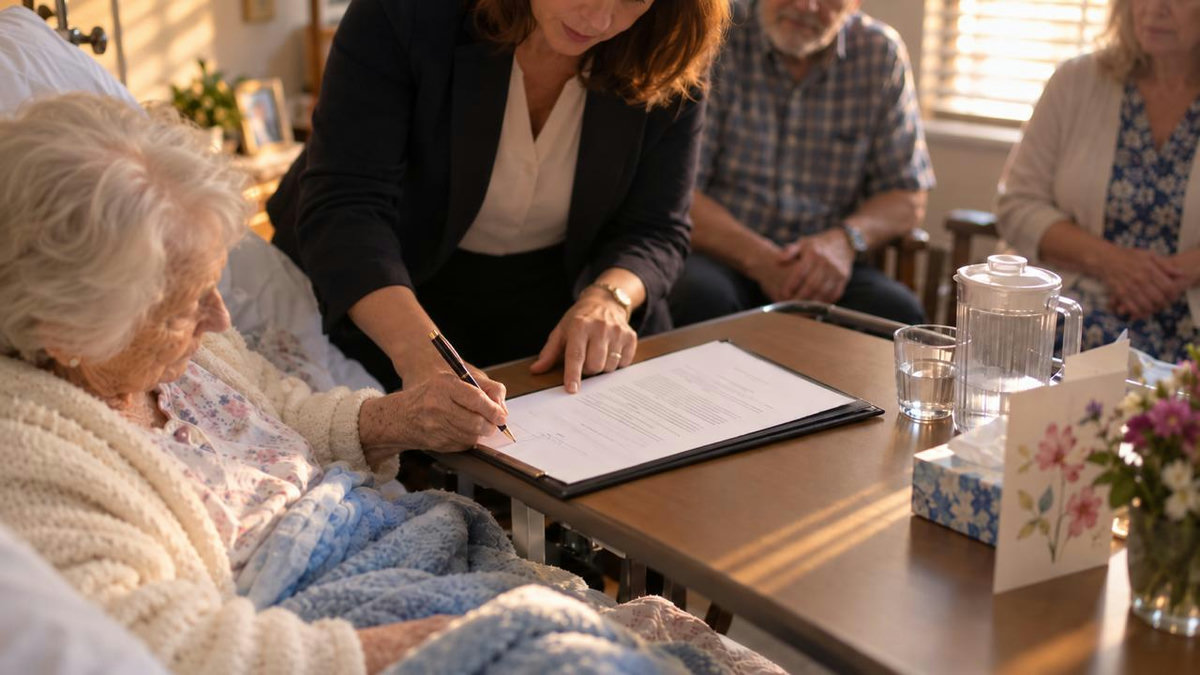
A family calls to schedule a notarization at a Manatee County nursing home or assisted living facility, and partway through the appointment it becomes clear the resident can’t physically sign their name — a stroke, advanced arthritis, a tremor, or a weak grip from recent surgery. That doesn’t mean the appointment has to be cancelled. Florida notary law has specific, detailed procedures for exactly this situation.
The Statute: Reasonable Accommodations Are Required, Not Optional
Under Section 117.05(14), Florida Statutes, a notary public “must make reasonable accommodations to provide notarial services to persons with disabilities.” This isn’t a courtesy a notary extends at their discretion — it’s a statutory duty, and the statute lays out exactly what those accommodations look like depending on the resident’s situation.
Option 1: Signature by Mark
If the resident can still make some kind of mark — an X, a shaky approximation of their initial, a thumbprint — but can’t produce a full legible signature, Section 117.05(14)(b) covers it. The notary may notarize a signature made by mark if:
- The signing is witnessed by two disinterested persons (not the notary, and not someone with a stake in the document’s outcome);
- The notary prints the person’s first name at the beginning of the signature line and their last name at the end of the signature line; and
- The notary prints the words “his (or her) mark” below the mark itself.
Both witnesses need to actually watch the resident make the mark — this isn’t something that can be done after the fact. For a nursing home appointment, this usually means coordinating with facility staff or family members in the room ahead of time, since the notary needs two people present who aren’t the notary and aren’t the resident.
Option 2: The Notary Signs on the Resident’s Behalf
Some residents can’t make any mark at all — total paralysis on the signing side, severe tremor that produces nothing usable, or similar. Section 117.05(14)(d) allows the notary to sign the document on the resident’s behalf, but only under specific conditions:
- The resident must direct the notary to sign for them (the resident is still the one making the decision — the notary isn’t signing independently);
- The signing must be witnessed by two disinterested persons, same as the mark procedure; and
- The notary must keep a record of the circumstances for 10 years.
This is a higher bar than the signature-by-mark option, and it exists for situations where even a mark isn’t physically possible. It still requires the resident to be mentally capable of directing the notary to sign — this procedure addresses a physical inability to sign, not a question of mental capacity (that’s a separate issue; see our general nursing home notary FAQ for how capacity questions are handled).
A Related Accommodation: Blind Signers
The same subsection also covers a different disability scenario worth knowing about: under 117.05(14)(a), if the person signing is blind, the notary must read the entire instrument aloud to them before they sign. It’s a different accommodation for a different disability, but it’s part of the same statutory framework and can come up in the same facility settings.
Why This Matters in Manatee County Specifically
Manatee County has a significant concentration of skilled nursing and assisted living facilities, from Bradenton to Lakewood Ranch to Palmetto, serving a population where physical signing limitations from stroke, Parkinson’s, severe arthritis, or post-surgical recovery are common. A mobile notary who regularly works these facilities needs to recognize, before the appointment, when a mark or on-behalf-of signature is likely to be needed — because both procedures require two disinterested witnesses physically present, and that’s much easier to arrange in advance than to scramble for mid-appointment.
What to Have Ready Before the Appointment
If there’s any reason to think the resident may not be able to sign normally:
- Line up two disinterested witnesses who can be in the room — facility staff (if the facility allows it) or family members who aren’t parties to the document.
- Let the notary know in advance so they can bring the right certificate language; Florida law provides specific statutory certificate forms for both the signature-by-mark and on-behalf-of-signing scenarios.
- If there’s any question about whether the resident is mentally able to direct their own affairs (as opposed to just physically unable to sign), raise that separately — physical signing accommodations and mental capacity are two different legal questions.
Scheduling a Mobile Signing at a Manatee County Facility
Tampa Bay Signing Services handles mobile notary appointments at nursing homes and assisted living facilities throughout Manatee County. If an upcoming appointment may involve a resident who can’t sign normally, let us know when you book so we can confirm witness arrangements ahead of time rather than discovering the issue at the bedside.
Contact Tampa Bay Signing Services with the facility, resident’s situation, and appointment details, and we’ll help plan accordingly.
Important Information
This article is provided for general educational purposes and is not legal advice. Whether a particular document or situation requires an attorney’s involvement — for example, questions about a resident’s legal capacity, or what a given document actually does — should be directed to the family’s attorney. A notary’s role here is limited to the physical act of notarization under Florida’s accommodation procedures, not advising on the documents themselves.
Florida-law references in this article were reviewed October 2026.